
Description
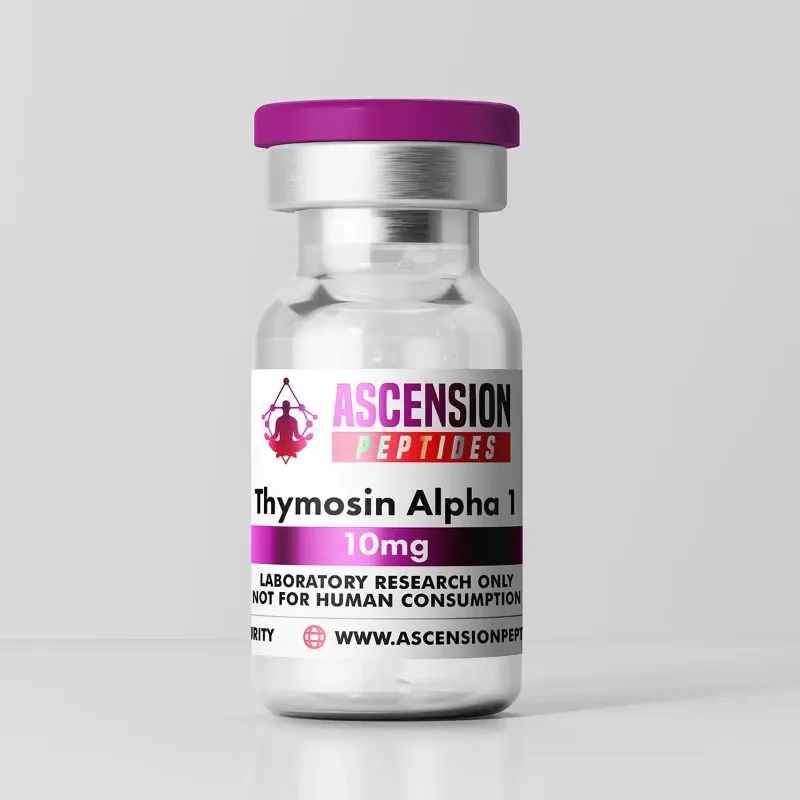
Our Thymosin Alpha-1 10mg vial holds 10mg of lyophilized Thymosin Alpha-1, a thymic peptide. It’s for in-vitro and lab research only.
What is Thymosin Alpha-1?
Thymosin alpha-1 is a 28-amino-acid peptide first isolated from thymus tissue. It acts on T-cell maturation and innate immune signaling.
A synthetic form, thymalfasin (Zadaxin), is approved in some countries outside the US for hepatitis B and C.
How Thymosin Alpha-1 acts in the lab
Thymosin alpha-1 acts on toll-like receptors, especially TLR2 and TLR9, on dendritic cells and other immune cells. That activates downstream signaling that helps T cells mature and shapes the response toward Th1 immunity.
It’s studied as an adjuvant alongside vaccines and in chronic viral infection models, where the goal is a stronger T-cell response without broad overstimulation.
Thymosin Alpha-1 10mg product details
- Compound: Thymosin Alpha-1
- Also known as: thymalfasin
- CAS number: 62304-98-7
- Molecular formula: C129H215N33O55
- Molar mass: 3,108.3 g/mol
- Structure: 28 amino acids, N-terminally acetylated
- Amount: 10mg per vial
- Form: lyophilized (freeze-dried) powder
- Label: compound name and amount printed on every unit
- SKU: PEP-THYMOSIN-10MG
- Use: laboratory research only
Published Thymosin Alpha-1 studies
Clinical work on thymalfasin covers chronic hepatitis B and as an immune adjuvant, reviewed by Goldstein and colleagues.
Lab studies describe its action through toll-like receptors on dendritic cells.
To read the papers yourself, start with this PubMed search for Thymosin alpha-1.
Thymosin Alpha-1 compared with similar compounds
Here’s how Thymosin Alpha-1 10mg fits among related compounds. Thymosin Alpha-1 is a 28-amino-acid thymic peptide, approved in several countries as thymalfasin. By comparison:
- LL-37 is the only human cathelicidin, an antimicrobial peptide that also signals in wound repair
- VIP is a 28-amino-acid neuropeptide that relaxes smooth muscle and calms immune cells
These are all studied in immune research, but at different points: the thymus peptides on T-cell maturation and signaling, LL-37 on direct antimicrobial action and VIP on calming inflammation. See them all on our immune peptides page.
Thymosin Alpha-1 10mg quality and handling
Every Thymosin Alpha-1 10mg vial carries a printed label with the compound name and amount, so you always know what you’re holding. If your lab needs batch paperwork for its records, contact Ascension Peptides support before you order and ask what’s available for the current batch.
Labs that check material in-house normally confirm identity with mass spectrometry, which checks the molecular weight, and measure purity with HPLC, which separates the main compound from anything else in the sample.
Keep a record of which vial went into which experiment. Matching results to material is the simplest way to rule it out when an experiment doesn’t behave.
Reconstituting Thymosin Alpha-1 10mg
The amount of liquid you add sets the concentration. For a vial holding 10mg:
- 1mL of bacteriostatic water gives 10mg/mL
- 2mL of bacteriostatic water gives 5mg/mL
- 3mL of bacteriostatic water gives 3.33mg/mL
Pick the volume that keeps your own calculations simple, then write the concentration and the mixing date on the label.
Use sterile bacteriostatic water. Let the vial reach room temperature, run the water slowly down the inside of the glass, then roll the vial gently until the powder dissolves. Don’t shake it. Shaking can shear peptide chains.
Storing Thymosin Alpha-1 10mg
The dry powder keeps best cold and dark. A freezer at -20°C is right for long-term storage. After reconstitution, store it in the fridge at 2 to 8°C and finish it within roughly four weeks.
Leave sealed vials sealed until you need them. Dry powder in a closed vial lasts far longer than solution, so there’s no reason to mix more than one at a time.
Planning a study with Thymosin Alpha-1 10mg
Start from the protocol. Total the amount every arm needs from the first time point to the last, divide by the 10mg in a vial and add a spare. It’s cheaper to order once than to wait on a second shipment halfway through.
Only reconstitute what you’ll use in the next few weeks. Sealed vials stay stable in the freezer, while a mixed vial should be finished within about 28 days.
If you order more than one vial, check that the batch numbers match before you start. Running a whole study on one batch removes one variable.
Related to Thymosin Alpha-1 10mg
- VIP 10mg, a neuropeptide
- LL-37 10mg, an antimicrobial peptide
- ARA-290 10mg, an EPO-derived peptide
- KPV 10mg, an alpha-MSH tripeptide
- BPC-157 5mg, a 15-amino-acid peptide
Browse the full immune peptides range, see every vial on our research peptides page or head back to the Ascension Peptides home page.
Thymosin Alpha-1 10mg FAQ
How much is in the Thymosin Alpha-1 10mg vial?
10mg of freeze-dried powder. The amount is printed on the label.
What do I mix Thymosin Alpha-1 10mg with?
Sterile bacteriostatic water is the usual choice. The reconstitution section above shows the concentration for each volume.
How should I store it?
Keep sealed vials in the freezer at -20°C. Once mixed, refrigerate at 2 to 8°C and use within about 28 days.
Can Thymosin Alpha-1 be used in people or animals?
No. It’s sold for laboratory research only and isn’t approved for human or veterinary use.
Is Thymosin Alpha-1 10mg in stock?
Yes. Thymosin Alpha-1 10mg is in stock and ready to ship.
Buy Thymosin Alpha-1 10mg from Ascension Peptides
Thymosin Alpha-1 10mg is in stock at $99.99 per vial. Add it to the cart, enter code ASCENSION10 at checkout for 10% off, and shipping is free worldwide.
Need more for the same project? See the rest of our immune peptides, or go back to the Ascension Peptides home page.
For laboratory research use only. Not for human or veterinary use. These statements have not been evaluated by the FDA.
Reviews
There are no reviews yet.