
Description
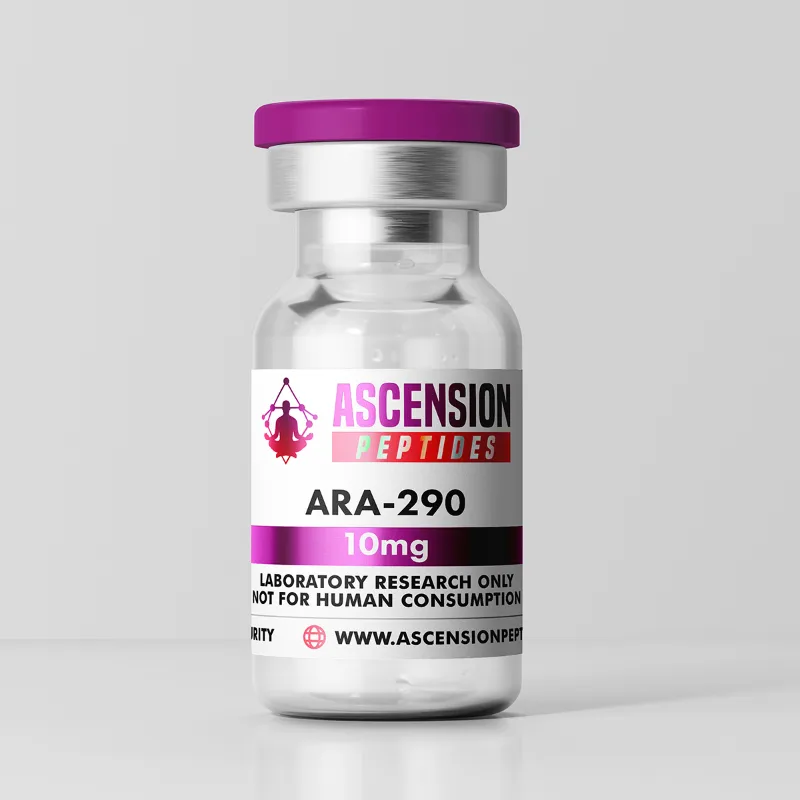
Our ARA-290 10mg vial holds 10mg of lyophilized ARA-290, an erythropoietin-derived peptide. It’s for in-vitro and lab research only.
What is ARA-290?
ARA-290 (cibinetide) is an 11-amino-acid peptide based on a region of erythropoietin. It activates the tissue-protective receptor without stimulating red blood cell production.
Araim Pharmaceuticals developed it for small fiber neuropathy.
How ARA-290 acts in the lab
Erythropoietin (EPO) has two jobs. It drives red blood cell production through one receptor, and it protects tissue through another, a complex of the EPO receptor with CD131.
ARA-290 mimics the small part of EPO that binds the tissue-protective receptor and leaves the red blood cell receptor alone. That lets researchers study EPO’s anti-inflammatory and nerve-protective effects without raising hematocrit.
ARA-290 10mg specifications
- Compound: ARA-290
- Also known as: cibinetide
- CAS number: 1208243-50-8
- Molar mass: 1,257.3 g/mol
- Structure: 11 amino acids (pGlu-Glu-Gln-Leu-Glu-Arg-Ala-Leu-Asn-Ser-Ser)
- Amount: 10mg per vial
- Form: lyophilized (freeze-dried) powder
- Label: compound name and amount printed on every unit
- SKU: PEP-ARA-290-10MG
- Use: laboratory research only
ARA-290 research
In a phase 2 study, Brines and colleagues reported that ARA-290 improved symptoms and corneal nerve fiber density in patients with sarcoidosis-related small fiber neuropathy.
Animal studies looked at nerve and kidney protection.
The primary literature is on PubMed, run by the US National Library of Medicine. Here’s a search for ARA-290 studies to start from.
ARA-290 compared with similar compounds
Labs choosing ARA-290 10mg usually weigh it against a few close relatives. ARA-290 is an 11-amino-acid peptide from erythropoietin that protects tissue without raising red cells, while:
- BPC-157 is the 15-amino-acid repair peptide with the largest body of rodent research
- TB-500 is the 43-amino-acid actin-binding protein, studied for cell movement and wound repair
- KPV is a three-amino-acid alpha-MSH fragment studied for calming inflammation
- GHK-Cu is the copper-binding tripeptide studied for collagen and skin repair
These are the main peptides in repair research. Each covers a different step, from blood vessel growth and cell movement to calming inflammation and rebuilding the skin matrix. See them all on our healing and recovery peptides page.
ARA-290 10mg reconstitution and concentration
Here’s the math for 10mg of powder:
- 1mL of bacteriostatic water gives 10mg/mL
- 2mL of bacteriostatic water gives 5mg/mL
- 3mL of bacteriostatic water gives 3.33mg/mL
Choose the volume that suits your measurements. Mark the vial with the concentration and date so nobody has to guess later.
Bacteriostatic water is the usual choice, and a little dilute acetic acid helps with peptides that won’t dissolve in water alone. Add it slowly so it runs down the side of the vial, then swirl or roll until everything dissolves. Shaking can shear peptide chains. Skip it.
Storing ARA-290 10mg
Store sealed vials of ARA-290 10mg in the freezer at -20°C, out of direct light. Mixed solution goes in the fridge at 2 to 8°C and should be used within about 28 days.
Running several vials at once? Keep them upright in a closed box on one fridge shelf, labels facing out, so nobody grabs the wrong one.
Checking your ARA-290 10mg
Ascension Peptides labels each ARA-290 10mg vial with the compound and the amount. Labs that file batch documentation should ask our support team about the current batch before ordering.
If you verify incoming material yourself, the standard methods are HPLC for purity and mass spectrometry for identity. HPLC splits the sample and reports the main peak as a percentage, while mass spec confirms that peak has the right molecular weight.
Keep a record of which vial went into which experiment. Matching results to material is the simplest way to rule it out when an experiment doesn’t behave.
Planning a study with ARA-290 10mg
Start from the protocol. Total the amount every arm needs from the first time point to the last, divide by the 10mg in a vial and add a spare. It’s cheaper to order once than to wait on a second shipment halfway through.
Mix one vial at a time and keep the rest sealed in the freezer. Dry powder keeps far longer than solution, so there’s no reason to reconstitute everything at the start.
If you order more than one vial, check that the batch numbers match before you start. Running a whole study on one batch removes one variable.
Often ordered with ARA-290 10mg
- GHK-Cu 100mg 10mL, a copper peptide
- BPC-157 10mg, a 15-amino-acid peptide
- KLOW Blend 80mg, GHK-Cu, BPC-157, TB-500 and KPV in one vial
- Wolverine Stack 20mg, BPC-157 and TB-500 in one vial
- TB-500 5mg, a thymosin beta-4 peptide
Browse the full healing and recovery peptides and immune peptides range, see every vial on our research peptides page or head back to the Ascension Peptides home page.
ARA-290 10mg FAQ
How much is in the ARA-290 10mg vial?
10mg of freeze-dried powder. The amount is printed on the label.
Can ARA-290 be used in people or animals?
No. It’s sold for laboratory research only and isn’t approved for human or veterinary use.
Is ARA-290 10mg in stock?
Yes. This vial is in stock and ready to ship.
Where can I buy ARA-290 10mg?
Right here at Ascension Peptides. Add this vial to the cart on this page and it ships free worldwide.
What do I mix ARA-290 10mg with?
Sterile bacteriostatic water is the usual choice. The reconstitution section above shows the concentration for each volume.
Buy ARA-290 10mg online
Ready to order? ARA-290 10mg costs $79.99 per vial and is in stock. Use code ASCENSION10 for 10% off, and shipping costs nothing wherever you are.
Need more for the same project? See the rest of our healing and recovery peptides and immune peptides, or go back to the Ascension Peptides home page.
For laboratory research use only. Not for human or veterinary use. These statements have not been evaluated by the FDA.
Reviews
There are no reviews yet.