
Description
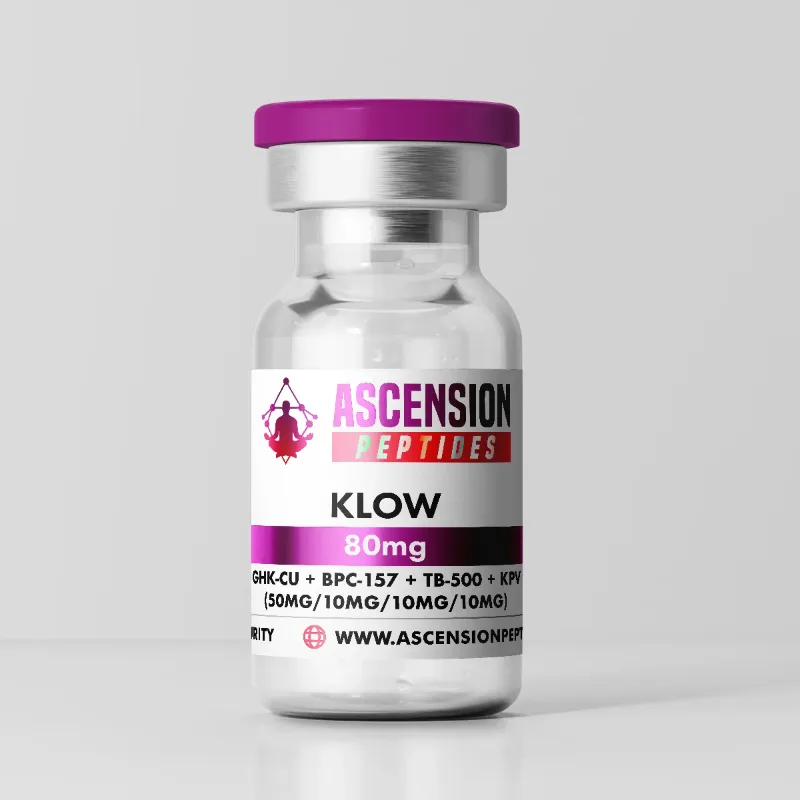
KLOW Blend 80mg puts 50mg GHK-Cu, 10mg BPC-157, 10mg TB-500 and 10mg KPV into one sealed vial so you reconstitute once instead of four times. It’s sold for laboratory research only.
What’s in the KLOW Blend 80mg?
GHK-Cu is the tripeptide glycyl-L-histidyl-L-lysine bound to a copper(II) ion. Loren Pickart first isolated GHK from human plasma in 1973, and levels in plasma are reported to fall with age.
BPC-157 is a 15-amino-acid peptide based on a fragment of body protection compound, a protein first found in gastric juice. It’s one of the most widely studied research peptides, almost entirely in rodents.
TB-500 here means thymosin beta-4, a 43-amino-acid protein found in nearly every cell in the body, with high levels in platelets and white blood cells. Inside the cell it binds actin, the protein cells use to change shape and move.
KPV is the tripeptide lysine-proline-valine, the C-terminal end of alpha-melanocyte stimulating hormone. It keeps alpha-MSH’s anti-inflammatory activity without the pigment effects.
KLOW is GLOW with KPV added. KPV is a three-amino-acid fragment of alpha-MSH studied for calming inflammation through NF-kB, so KLOW covers the inflammatory side of repair as well as the three steps GLOW targets.
The label prints the split: 50mg of GHK-Cu with 10mg each of BPC-157, TB-500 and KPV, 80mg in total. Because everything is freeze-dried together, the ratio can’t drift the way it can when you mix separate vials. One reconstitution, one label, the same proportions in every draw.
How the KLOW Blend 80mg works
GHK binds copper tightly and can deliver it to cells. Copper is a cofactor for lysyl oxidase, the enzyme that cross-links collagen and elastin, and for antioxidant enzymes.
Nobody has pinned down a single receptor for BPC-157. Lab studies point to several pathways: it raises VEGF receptor expression, which feeds blood vessel growth, it interacts with the nitric oxide system, and it increases growth hormone receptor levels in tendon cells.
Thymosin beta-4’s main job is holding on to G-actin, the single building blocks of the cell’s internal scaffolding. By controlling how much actin is free to polymerize, it controls how cells move and change shape.
Alpha-MSH calms inflammation through melanocortin receptors. KPV is its last three amino acids and keeps much of that anti-inflammatory activity.
KLOW Blend 80mg product details
- GHK-Cu, 50mg: CAS 89030-95-5, C14H22CuN6O4, 401.9 g/mol
- BPC-157, 10mg: CAS 137525-51-0, C62H98N16O22, 1,419.5 g/mol
- TB-500 (thymosin beta-4), 10mg: CAS 77591-33-4, C212H350N56O78S, 4,963.4 g/mol
- KPV, 10mg: CAS 67727-97-3, C16H30N4O4, 342.4 g/mol
- Amount: 80mg in total (50mg/10mg/10mg/10mg per vial)
- Form: lyophilized (freeze-dried) powder
- Label: compound name and amount printed on every unit
- SKU: PEP-KLOW-80mg
- Use: laboratory research only
What the research says about KLOW Blend
Maquart and colleagues reported in 1988 that GHK-Cu stimulated collagen synthesis in cultured fibroblasts, and later rat wound-chamber studies found more collagen and glycosaminoglycan buildup.
Most of the work comes from Predrag Sikiric’s group at the University of Zagreb. Their rodent studies report faster healing of tendon, ligament, muscle and gut injuries, and Mikus and colleagues described improved burn wound healing in mice.
Goldstein and colleagues reviewed thymosin beta-4’s role in wound repair in 2012, covering faster closure of skin wounds and new blood vessel growth in animal models.
Dalmasso and colleagues reported in Gastroenterology (2008) that KPV reduced inflammation in mouse colitis models and was taken up through PepT1.
The primary literature is on PubMed, run by the US National Library of Medicine. Here’s a search for GHK-Cu, BPC-157, TB-500 and KPV studies to start from.
Other ways to buy BPC-157, GHK-Cu, KPV and TB-500
BPC-157, GHK-Cu, KPV and TB-500 also come in these products, in case a different format suits your study better:
- BPC-157 5mg (freeze-dried vial, $59.99)
- BPC-157 10mg (freeze-dried vial, $74.99)
- TB-500 5mg (freeze-dried vial, $60.00)
- KPV 10mg (freeze-dried vial, $79.99)
- GHK-Cu 100mg 3mL (freeze-dried vial, $84.99)
- GHK-Cu 100mg 10mL (freeze-dried vial, $94.99)
Checking your KLOW Blend 80mg
Every KLOW Blend 80mg vial carries a printed label with the compound name and amount, so you always know what you’re holding. If your lab needs batch paperwork for its records, contact Ascension Peptides support before you order and ask what’s available for the current batch.
Labs that check material in-house normally confirm identity with mass spectrometry, which checks the molecular weight, and measure purity with HPLC, which separates the main compound from anything else in the sample.
Keep a record of which vial went into which experiment. Matching results to material is the simplest way to rule it out when an experiment doesn’t behave.
Reconstituting KLOW Blend 80mg
Here’s the math for 80mg of powder:
- 2mL of bacteriostatic water gives 40mg/mL
- 3mL of bacteriostatic water gives 26.67mg/mL
- 5mL of bacteriostatic water gives 16mg/mL
Go with whichever number is easiest to work with in your protocol, and label the vial with the concentration and the date you mixed it.
Bacteriostatic water is the usual choice, and a little dilute acetic acid helps with peptides that won’t dissolve in water alone. Add it slowly so it runs down the side of the vial, then swirl or roll until everything dissolves. Shaking can shear peptide chains. Skip it.
How to store KLOW Blend 80mg
The dry powder keeps best cold and dark. A freezer at -20°C is right for long-term storage. After reconstitution, store it in the fridge at 2 to 8°C and finish it within roughly four weeks.
Leave sealed vials sealed until you need them. Dry powder in a closed vial lasts far longer than solution, so there’s no reason to mix more than one at a time.
Related to KLOW Blend 80mg
- KPV 10mg, an alpha-MSH tripeptide
- GHK-Cu 100mg 3mL, a copper peptide
- GLOW Blend 70mg, GHK-Cu, BPC-157 and TB-500 in one vial
- BPC-157 10mg, a 15-amino-acid peptide
- Wolverine Stack 20mg, BPC-157 and TB-500 in one vial
Browse the full healing and recovery peptides and skin and tanning peptides range, see every vial on our research peptides page or head back to the Ascension Peptides home page.
Common questions about KLOW Blend 80mg
How much is in the KLOW Blend 80mg vial?
50mg of GHK-Cu, 10mg of BPC-157, 10mg of TB-500 and 10mg of KPV, freeze-dried together. The amount is printed on the label.
Is KLOW Blend 80mg in stock?
Yes. KLOW Blend 80mg is in stock and ready to ship.
Where can I buy KLOW Blend 80mg?
Right here at Ascension Peptides. Add KLOW Blend 80mg to the cart on this page and it ships free worldwide.
What do I mix KLOW Blend 80mg with?
Sterile bacteriostatic water is the usual choice. The reconstitution section above shows the concentration for each volume.
How should I store it?
Keep sealed vials in the freezer at -20°C. Once mixed, refrigerate at 2 to 8°C and use within about 28 days.
Buy KLOW Blend 80mg online
Order KLOW Blend 80mg now for $199.99 a vial. It’s in stock, code ASCENSION10 takes 10% off at checkout, and we ship free to the US, Canada, Europe and Australia.
Need more for the same project? See the rest of our healing and recovery peptides and skin and tanning peptides, or go back to the Ascension Peptides home page.
For laboratory research use only. Not for human or veterinary use. These statements have not been evaluated by the FDA.
Reviews
There are no reviews yet.