
Description
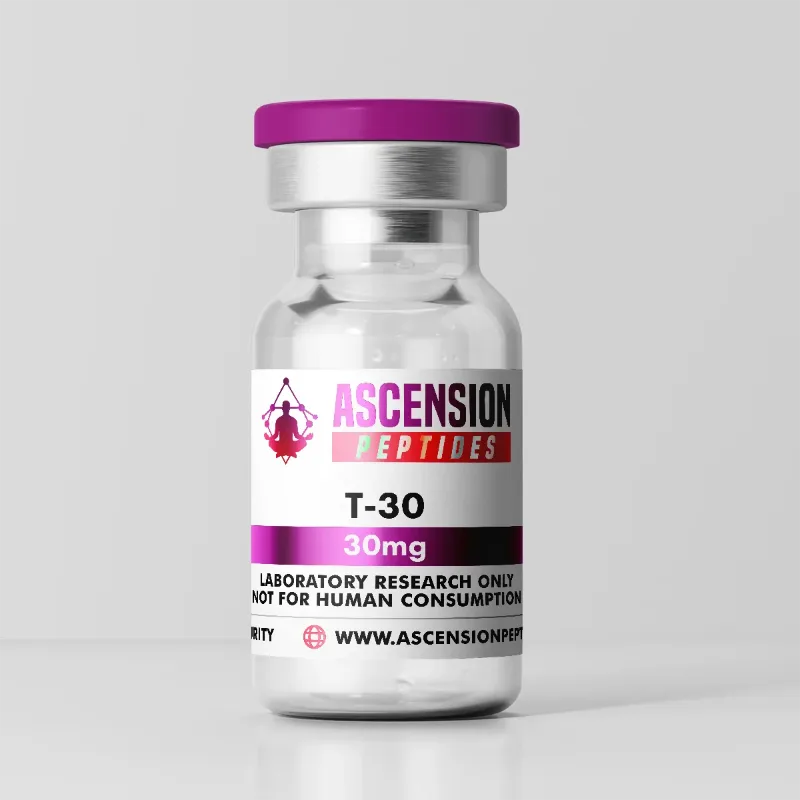
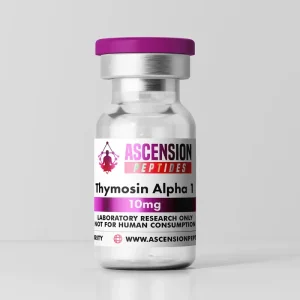
T-30 from Ascension Peptides is 30mg of tirzepatide in a sealed glass vial. Tirzepatide is a dual GIP and GLP-1 receptor agonist. It’s intended for lab research only.
T-30 is our code name for tirzepatide. The compound inside the vial is tirzepatide, and everything below describes it.
About tirzepatide
Tirzepatide is a 39-amino-acid peptide from Eli Lilly that activates two receptors, GIP and GLP-1. A fatty acid side chain lets it bind albumin, so its half-life is about five days. It’s approved as Mounjaro for type 2 diabetes and as Zepbound for weight management.
How tirzepatide acts in the lab
Tirzepatide activates two incretin receptors. GIP and GLP-1 are both released by the gut after eating, and both push the pancreas to release insulin when glucose is high. GLP-1 also slows stomach emptying and acts on appetite centers in the brain.
The molecule is built on the GIP sequence and tuned to hit the GLP-1 receptor as well. It leans toward GIP in binding strength. A C20 fatty diacid lets it ride on albumin, so it lasts days instead of minutes.
T-30 specifications
- Compound: Tirzepatide
- Also known as: LY3298176
- CAS number: 2023788-19-2
- Molecular formula: C225H348N48O68
- Molar mass: 4,813.5 g/mol
- Structure: 39 amino acids with a C20 fatty diacid side chain
- Amount: 30mg per vial
- Form: lyophilized (freeze-dried) powder
- Label: compound name and amount printed on every unit
- SKU: PEP-TIRZ-30MG
- Use: laboratory research only
What the research says about tirzepatide
The SURMOUNT-1 trial (New England Journal of Medicine, 2022) reported average weight loss of up to about 21% over 72 weeks at the highest dose. The SURPASS trials covered blood sugar control in type 2 diabetes.
The primary literature is on PubMed, run by the US National Library of Medicine. Here’s a search for tirzepatide studies to start from.
How tirzepatide compares
Labs choosing T-30 usually weigh it against a few close relatives. Tirzepatide adds GIP receptor activity to GLP-1, a dual agonist with larger weight effects than semaglutide in trials, while:
- Semaglutide acts on the GLP-1 receptor only and lasts about a week, the most studied compound in the group
- Retatrutide hits GLP-1, GIP and glucagon receptors, the triple agonist with the biggest phase 2 numbers so far
- Cagrilintide works through amylin receptors instead of incretins, often studied next to or with semaglutide
The main difference between these compounds is which receptors they hit. Pick the one that matches the receptor question in your study, and use the others as comparisons. See them all on our GLP-1 peptides page.
T-30 quality notes
The vial label shows the compound and the amount. For anything your lab needs on file beyond that, email Ascension Peptides support with the product name before you place the order.
Many labs run their own identity check when a new batch arrives. For peptides, purity is usually measured by HPLC, which separates a sample into its parts and reports the main compound as a share of the total. Mass spectrometry is often run alongside it to confirm the molecular weight.
If you run a long study, try to order everything you need at once and log it when it arrives. It removes one variable from your results.
Reconstituting T-30
Concentration is the amount in the vial divided by the volume of water you add. With 30mg of powder in this vial:
- 2mL of bacteriostatic water gives 15mg/mL
- 3mL of bacteriostatic water gives 10mg/mL
- 5mL of bacteriostatic water gives 6mg/mL
Pick the volume that keeps your own calculations simple, then write the concentration and the mixing date on the label.
Bacteriostatic water is the usual choice, and a little dilute acetic acid helps with peptides that won’t dissolve in water alone. Add it slowly so it runs down the side of the vial, then swirl or roll until everything dissolves. Shaking can shear peptide chains. Skip it.
Storing T-30
The dry powder keeps best cold and dark. A freezer at -20°C is right for long-term storage. After reconstitution, store it in the fridge at 2 to 8°C and finish it within roughly four weeks.
Let a frozen vial warm up to room temperature before you open it. Cold glass pulls moisture out of the air, and moisture is what degrades dry peptide.
Other tirzepatide strengths
- T-10: $124.99, about $12.50 per mg
- T-30 (this page): $199.99, about $6.67 per mg
For longer projects a larger vial like this vial means fewer vials to mix and fewer reorders.
Related to T-30
- S-5, a GLP-1 agonist
- C-10, an amylin analog
- R-10, a triple agonist
- MOTS-c 10mg, a mitochondrial peptide
- AOD-9604 5mg, an hGH fragment
Browse the full GLP-1 peptides and weight loss peptides range, see every vial on our research peptides page or head back to the Ascension Peptides home page.
T-30 FAQ
How much is in the T-30 vial?
30mg of freeze-dried powder. The amount is printed on the label.
What is T-30?
T-30 is the Ascension Peptides catalog name for tirzepatide. The vial holds tirzepatide as freeze-dried powder.
Where can I buy T-30?
Right here at Ascension Peptides. Add this vial to the cart on this page and it ships free worldwide.
What do I mix T-30 with?
Sterile bacteriostatic water is the usual choice. The reconstitution section above shows the concentration for each volume.
How should I store it?
Keep sealed vials in the freezer at -20°C. Once mixed, refrigerate at 2 to 8°C and use within about 28 days.
Buy T-30 from Ascension Peptides
T-30 is in stock at $199.99 per vial. Add it to the cart, enter code ASCENSION10 at checkout for 10% off, and shipping is free worldwide.
Need more for the same project? See the rest of our GLP-1 peptides and weight loss peptides, or go back to the Ascension Peptides home page.
For laboratory research use only. Not for human or veterinary use. These statements have not been evaluated by the FDA.
Reviews
There are no reviews yet.